Wednesday, February 28, 2018

Reading Notes: Mahabharata Online, Part C

I continued with the reading of the third part of the online domain edition. I have continued to enjoy these stories and the creativeness they have to offer. I again took notes over the one or two stories that I liked the best.


  • I found the Pandavan exile to be much more saddening that Rama's exile
  • I think Rama maintained a sense of appreciation and hope
  • However, the Pandavan's came across as angry and bitter for what had happened
  • This is understandable
  • The loss of their kingdom and fortune is devastating
  • I think it would be cool to explore the stories not mentioned in the online edition
  • I could write about their travels and stories with the different sages in the forest
  • The promise of the return of their kingdom in due time is somewhat redeeming
  • It ensures that not all hope and drive was lost
  • The arrival of Krishna brings about a new fold in the story
  • His dialogue is lengthy and contains a lot of detail
  • He explains that his next actions to restore the kingdom are not easy
  • Draupadi does not have the patience to see her kingdom restored
  • She has anger and sadness in her voice as she longs for material possessions once more
  • Yudhishthira offers great advice and explains to her that she must forgive
  • Anger is never the answer
  • Draupadi begins the question the gods and how they could allow such travesty to occur
I think the internal conflict that the exiled group is experiencing is really important. I could write about a section of this and explore this conflict. Yudhishthira is very patient and does not jump aboard the train of sadness and hate.


(A photo of a book. Source: Flickr)

Bibliography: Public Domain Edition Mahabharata, from Indian Myth and Legend by Donald A. Mackenzie. Source: PDE

Friday, February 23, 2018

Week 6 Story: Rama Bends The Bow

Update: You can find the final edition of this story here!


Long ago, during the time of Rama and his many adventures, King Janaka set forth a challenge to any man that would accept. The challenge set forth by the king was of vast importance for many people. King Janaka was known to have a daughter, Sita, that was far more beautiful than any man could possibly imagine. She was known far and wide for her wondrous looks that would leave any man with a desire to be with her. At the time, Prince Rama was unaware of Sita's existence. It just so happened that he would cross her path as he was visiting the allied kingdom of King Janaka.

Rama had recently been on an expedition to ride the surrounding areas of evil demons that had been terrorizing the lands. His brother, Lakshmana, was accompanying Rama on their recent journey to the allied kingdom. As Rama and his brother were walking about the royal garden of the allied kingdom, Rama was able to catch a glimpse of the beautiful princess Sita. An instant connection was born when the two locked eyes.

The crazy thing about Sita and Rama is that they were both connected by the heavens. Rama and Sita were avatars of two gods that were heavenly lovers. It was not a coincidence that they would find each other in such a moment.

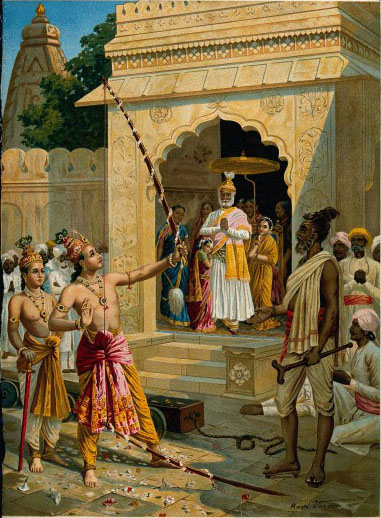
The next day, Rama went straight to the King and his monarch to take on the challenge of stringing Shiva's bow. Many men from far and wide had attempted this challenge without the slightest bit of success. However, none of these men were Rama. Rama, the avatar of Vishnu, had strength and power that no ordinary man could ever possess. He took the bow in his hand and strung it with ease. The ground began to tremble and a loud bang rang across the city. Everyone looked on in disbelief at what Rama had so effortlessly done.

With Rama's incredible feat of strength, he was permitted to wed Sita. Their many adventures together were just coming to fruition.

(A photo of Rama stringing and breaking the bow. Source: Wikimedia Commons)


Author's Note: The story I told was a retelling of Rama's incredible feat of winning over his wife Sita. I kept the details mostly the same to the source. I just added my own personal voice to the story. The outcome is the same in the source story. Rama is able to win the hand of Sita in marriage and the rest is history.

Bibliography: The Divine Archer by F. J. Gould. Source: archives.

Thursday, February 22, 2018

Reading Notes: Mahabharata, Part B

So I continued with the second part of the reading today. There are a lot of different stories and loads of information. I decided to take notes over the one that I liked the best.


  • Vidura is one of my favorite characters from all of the stories
  • He is not considered to be eligible for the royal positions
  • However, he is still a prince and cares greatly for his family
  • I appreciate his loyalty and dedication to his family
  • He could be bitter about having a mother that was not a royal
  • However, he warns his family of the imminent danger that they were in
  • I think the escape from the palace is really cool
  • It was an interesting plan to have a miner dig a passage out of the palace
  • I was expecting something to possibly go wrong, but it did not
  • It was not until the evil captain was burned
  • The lac palace went down in flames with the guard house
  • I thought the celebration of King Dhritarashtra was premature
  • I was really excited to see the big reveal when he finds out that they did not actually die
  • It was unfortunate to see the woman and her family died
  • However, it is a vital bit of information that sets up for later on in the story
So, I think the House of Fire would be a really awesome story to retell. I think I will alter a few things in my retelling though. I would like to add in more chaos and conflict. There is a really cool opportunity with this story to expand it and make it more detailed. I would possibly like to explore the events that unfold afterwards. 


(A picture of a book on a beach. Source: Flickr)

Bibliography: The Mahabharata, A Summary by John Mandeville Macfie. Source: PDE

Wednesday, February 21, 2018

Reading Notes: Mahabharata, Part A

The start of the new reading began today. I really enjoyed some of these stories. I think the reading style is easy to follow and entertaining. I took some notes over the stories that I liked the best.

  • Each character is introduced with an elaborate backstory
  • I usually do not write much about character's before their introduction
  • I might try this kind of writing style
  • I liked the first few sections that gave the read a lot of information
  • I found that it can be a bit too much at times
  • There are lots of names to learn quickly and apply to the reading
  • I think I could maintain my own writing style while also adapting to these stories
  • I would like to possibly write a whole story as an "intro"
  • The idea of taking women in battle was one that I had not seen 
  • I was expecting a more heroic adventure or tale
  • Taking the women as victors for a battle was a bit different
  • The stories are definitely more on the erotic side as no details are held back
  • I found this to be a contrast from the Ramayana
  • I think I could retell Pandu's life and some of his brief adventures
  • It was a but unfortunate the way he passed
  • He had been cursed and would end up dying in the arm's of one of his wives
  • I think there could be some cool stories to tell from this
  • I could also just create my own stories
  • What if he did not sell his possessions and go live in the forest?
  • Would he have survived the curse?
  • I would like to explore this idea a bit more
I found that some of the stories contain lots of small bits of information. I noticed everything builds upon itself as new characters are constantly introduced along with new kingdoms.

(A reading squirrel. Source: Pixaby)


Bibliography: The Mahabharata, A Summary by John Mandeville Macfie. Source: PDE

Wednesday, February 14, 2018

Reading Notes: The Divine Archer, Part B

So, I finished up part B of the reading today. I have really been enjoying this version of the Ramayana. I think reading all of the stories a second time has allowed me to appreciate and better understand what is taking place. I took notes on my favorite sections/scenes.


  • The relationship between Rama and Sugriva is one of my favorites in the epic
  • I really like how they become the best of allies and vow to help each other reclaim their kingdoms
  • I think the fighting scene between Rama, Sugriva, and Vali is the highlight
  • There is a lot of potential for a cool story to be told there
  • I was initially surprised at Rama's decision to ambush Vali
  • However, I think he was just trying to stay loyal to a new friend
  • I know there is a lot of argument over Rama's action
  • I would like to possibly give my interpretation on what his intentions were
  • I also think the quest to find Sita would be fun to explore
  • I would not cover Rama as much if this were the case
  • I might explore how Rama feels during all of this
  • However, I think Hanuman deserves his own story here
  • Hanuman played a vital role that I do not think is emphasized enough
  • I am also curious to explore Sita's exile
  • I found her exile to be a bit unfair and extreme
  • It would be cool to write about that or possibly make up a new storyline
Again, I really enjoyed reading this version of the Ramayana. I found it really fun to go back through these stories one more time. 


(Someone reading a book. Source: Flickr)

Bibliography: The Divine Archer, by F. J. Gould. Source: archives

Reading Notes: The Divine Archer, Part A

I really enjoyed reading F. J. Gould's version of the Ramayana. I found it to be much easier to follow as the English and writing style was a bit more modern. I did not have to constantly read something over to understand what was going on in the story. I jotted down some points about things that I liked from the first few sections of this reading. 

  • The description of Rama and his birth was very detailed 
  • It included the descriptions of his heaven like markings and the intuition of his mother
  • The foresight of his mother to see him turn into a divine being was a nice addition
  • The people and the city adorned and loved Rama
  • Rama and his brother's accounts with slaying the demons was awesome
  • The dialogue between the hermit and the king was easy to understand
  • I found that in the past I would get lost in the dialogue
  • This clarity is something that I definitely want to mimic
  • The scene where Rama sees Sita is great descriptively
  • It displays the internal dialogue of Rama as he takes his first glance at his future wife
  • I think it does a great job foreshadowing of what is about to come
  • The challenge of winning over Sita was written very well and stays true to the source
  • I liked reading about Rama breaking the axe and stringing Vishnu's bow
  • I think this is a story that I would like to recreate
  • I could do a really cool retelling similar to that of King Arthur
  • The succession is an emotional turn of events
  • Rama's father was eager to make Rama the successor the the throne
  • The conflict that Rama faces is tough to read
  • It is unfortunate that Kaikeyi has such a strong impact on Rama's future
  • I wrote about this last week, but I still think there are more thing I could add to the story
(A photo of a statue of Rama, taken by adityamadhav83. Source: Wikimedia Commons)

Overall, I really enjoyed this week's reading option. I think it helped immensely that this was my second time reading about Rama and his adventures. I found this week's reading to be much easier to follow. I am glad that I was able to revisit these stories. I feel like I am able to fully appreciate them this time around.


Bibliography: The Divine Archer by F. J. Gould. Source: archives.

Friday, February 9, 2018

Comment Wall

Here is the link to my portfolio! I look forward to reading everyone's feedback.

(The image used here is a photo from the Ramayana. It was released by the Los Angeles County Museum of Art and can be found here.)